The transmitted text of Annals 15.44 says that the group called Christianos or Chrestianos took its name from Christus, who was executed under Tiberius by Pontius Pilate. Tacitus does not give the name Jesus or identify his source. The Annals is conventionally dated to about 116 CE; its direct manuscript witness for this section is an 11th-century codex.
What the Latin passage says
Annals 15.44 appears in Tacitus' account of the fire in Rome and Nero's response. The passage says Nero blamed a hated group whom the crowd called Christianos or Chrestianos. It then explains that the name came from Christus, executed under Tiberius by Pontius Pilate, and says the movement spread again from Judea to Rome.
The passage never uses the name Jesus, gives no exact year, cites no witness or record, and does not say how Tacitus learned the execution detail. The Latin says Christus received the death penalty; it does not specify crucifixion in that sentence. Tacitus mentions crucifixions later as one of Nero's punishments for members of the group.
Tacitus does not say the first people arrested confessed to setting the fire. The Latin leaves the object of their confession unstated. It then says a large number were convicted less on the charge of arson than for hatred of humankind. Those are claims about Nero's treatment of Christians in Rome, not independent testimony to Jesus' biography.
Christianos, Chrestianos, and Christus
The Latin word at the start of the passage is transmitted and edited as either Christianos or Chrestianos. Dickinson College Commentaries notes the spelling dispute and that Chrestianos is often preferred in current editions. The following sentence explicitly connects the group's name to Christus; that connection, rather than the spelling alone, carries the identification.
Suetonius separately writes that Claudius expelled Jews from Rome after disturbances instigated by ‘Chrestus’ (Claudius 25.4). Suetonius does not explain who Chrestus was. The two texts therefore preserve different names and different claims; their resemblance does not identify a person shared by both accounts.
The manuscript tradition contains no variant that removes the Christus sentence. The interpolation conclusion is an inference from the sentence's wording, title error, placement, and transmission—not a claim that a manuscript records its deletion.
The manuscript that transmits the passage
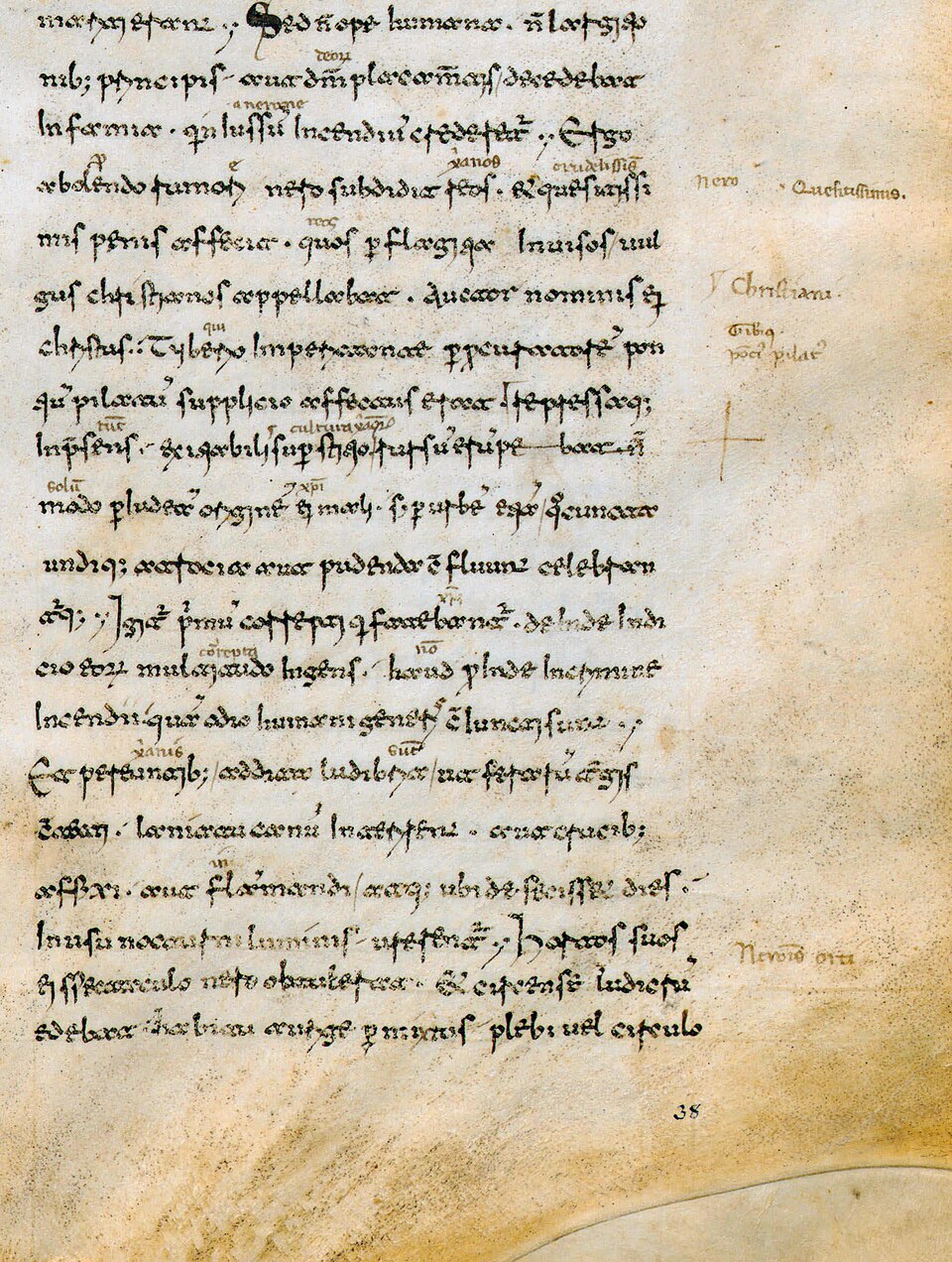
Annals books 11–16, including 15.44, are transmitted through one direct manuscript witness: Codex Laurentianus Mediceus 68.2, written in the 11th century. The folio shown here is page 38 recto. It documents the wording present in that medieval copy; it is not an autograph or a contemporary copy of Tacitus.
The Annals is conventionally dated to about 116 CE. That is a reconstructed date for the work's composition, not the date of this manuscript and not proof that the Christus sentence was already present in Tacitus' text. Under this site's reading, the sentence is an interpolation, so the conventional date of the Annals cannot establish a pre-144 attestation of Jesus.
Pilate's title is wrong
Tacitus' Latin calls Pilate a procurator (per procuratorem Pontium Pilatum). The contemporary Caesarea inscription records his office as prefect of Judea (praefectus Iudaeae). Tacitus himself distinguishes prefects from procurators in Annals 15.25. The Christus sentence gives Pilate the wrong title.
That historical error is evidence against the sentence being Tacitus' own reliable report. It supports the interpolation conclusion alongside the sentence's Christian naming formula, its unexplained source, and its late manuscript transmission. The case is cumulative; the title error is a clue, not a manuscript variant proving when the wording entered the text.
Nero, the fire, and later accounts
Suetonius also says Christians were punished under Nero (Nero 16.2), but does not connect that punishment to the fire or mention Christus, Jesus, or Pilate. Tertullian later appeals to histories that identify Nero as the first emperor to attack the Christian movement at Rome; he neither names Tacitus nor links Nero's actions to the fire in that passage.
Sulpicius Severus' early-fifth-century Chronicle explicitly pairs Nero's fire with the punishment of Christians. This is a much later account, not a contemporary record of the event. These later reports concern Christians and Nero; none provides an independently sourced account of Jesus' life.
What the passage establishes
The transmitted text contains a sentence that links the name Christus to an execution under Pilate. It does not name Jesus, cite an informant, or identify a Roman record. The sentence is transmitted in a medieval manuscript and gives Pilate the wrong title; it therefore does not establish a contemporary Roman source for the claim.
This site concludes that the Christus sentence is an interpolation on the combined evidence of its wording, context, title error, and transmission. Annals 15.44 does not establish Jesus' existence. That conclusion concerns the Christus sentence, not the separate account of the Nero fire.
The case
The Christus identification is a Christian interpolation. Tacitus' sentence names no Jesus, supplies no informant or Roman record, and uses a title for Pilate that conflicts with the contemporary Caesarea inscription. The textual and contextual evidence points to a later Christian alteration; this sentence is not independent Roman evidence for Jesus.
Conclusion
The Christus sentence is an interpolation, supported by its title error, wording, placement, and manuscript transmission. This conclusion concerns the sentence that identifies Christus; the rest of Tacitus' account of the Nero fire is a separate passage.