No contemporary, independent account establishes Jesus’ life. The first documentary references to a Gospel and letters attributed to Paul appear in later accounts of Marcion’s circle. There is no evidence that the Pauline collection predates Marcion. This site places that documentary horizon around 144 CE, a date reconstructed from later testimony; earlier composition dates are not dates recorded by contemporary witnesses.
Three dates that must stay distinct
A composition date estimates when a work was written. A manuscript date dates a physical copy. A first reference marks when another text mentions a person or work. These dates answer different questions; a proposed composition date is not a contemporary record.
There is no evidence that the Pauline collection or Gospel texts predate Marcion. Claims for first-century composition rely on reconstructed dates for the texts themselves; no contemporary witness supplies those dates. Later Christian accounts describe the Marcionite collection, while c. 144 CE is this site's reconstructed documentary horizon, not a date written in a publication record.
What the Marcion evidence actually says
Justin Martyr names Marcion as an active teacher but does not identify a Gospel or a collection of Paul's letters. Irenaeus later says Marcion used a Gospel associated with Luke and letters attributed to Paul; Tertullian gives a fuller account of those texts. The first explicit descriptions of the collection come from later Christian writers arguing against Marcion. There is no evidence that the Pauline collection predates Marcion.
Around 144 CE is the reconstructed horizon this site assigns to Marcion's activity and the Gospel-and-letter collection associated with his circle. Tertullian, writing later, records a chronology attributed to the Marcionites that places 115 years and six months between Christ and Marcion; that interval is used to calculate the date. It is not a report or manuscript from 144 listing those books, and it does not directly date each text's composition.
Paul is a claim within the texts
The letters speak in Paul's voice, but their first-person form does not independently verify who composed them. There is no evidence that the Pauline collection predates Marcion: its first documentary references occur in later Christian accounts of Marcion's circle. The dates assigned to the letters before that horizon are reconstructions, not dates supplied by contemporary witnesses. This site reads Paul as a second-century literary figure; no contemporary document establishes a first-century author named Paul.
The letters focus on revelation, scripture, disputes among communities, and a heavenly Lord. They do not give a continuous account of Jesus' public life. Galatians calls James “the Lord's brother,” but that phrase is internal to the letter; it is not an independent record of either author's identity or a biological relationship. The Paul and James page examines the wording and Marcionite textual reconstruction in detail.
The Gospels do not provide independent biographies
The Gospel texts do not name Matthew, Mark, Luke, or John as their narrators within their own accounts. Those names are later attributions. The Synoptic Gospels share episodes, order, and wording; for example, all three narrate the healing of a paralytic (Mark 2:1–12; Matthew 9:1–8; Luke 5:17–26). Their parallel accounts are literarily related, not three independent reports. The narratives also shape episodes through Israel's scriptures.
These texts establish what their writers and communities said about Jesus. Their titles do not independently verify author identity or composition dates, and their shared material does not supply separate confirmation for the same events. The Gospels page compares their attributions, shared passages, and literary sequence.
What would count as contemporary evidence?
A contemporary attestation would be a text or object created during the period assigned to Jesus’ life that identifies him as a person and reports something about his life or death. A later author placing a story in that period does not meet that standard; neither does a later reference to people who worship Christ.
No inscription, letter, administrative record, court document, or narrative written during the proposed lifetime names Jesus or records his execution. The dates assigned to his life come from later texts, not from contemporary documentation.
Philo and the Pilate evidence
Philo of Alexandria wrote during the period assigned to Jesus’ life. In Embassy to Gaius 299–305, he describes Pontius Pilate’s dispute over gilded shields in Jerusalem and criticizes Pilate’s conduct. Philo does not mention Jesus. His account records Pilate’s administration; it offers no account of the person described in the Gospels.
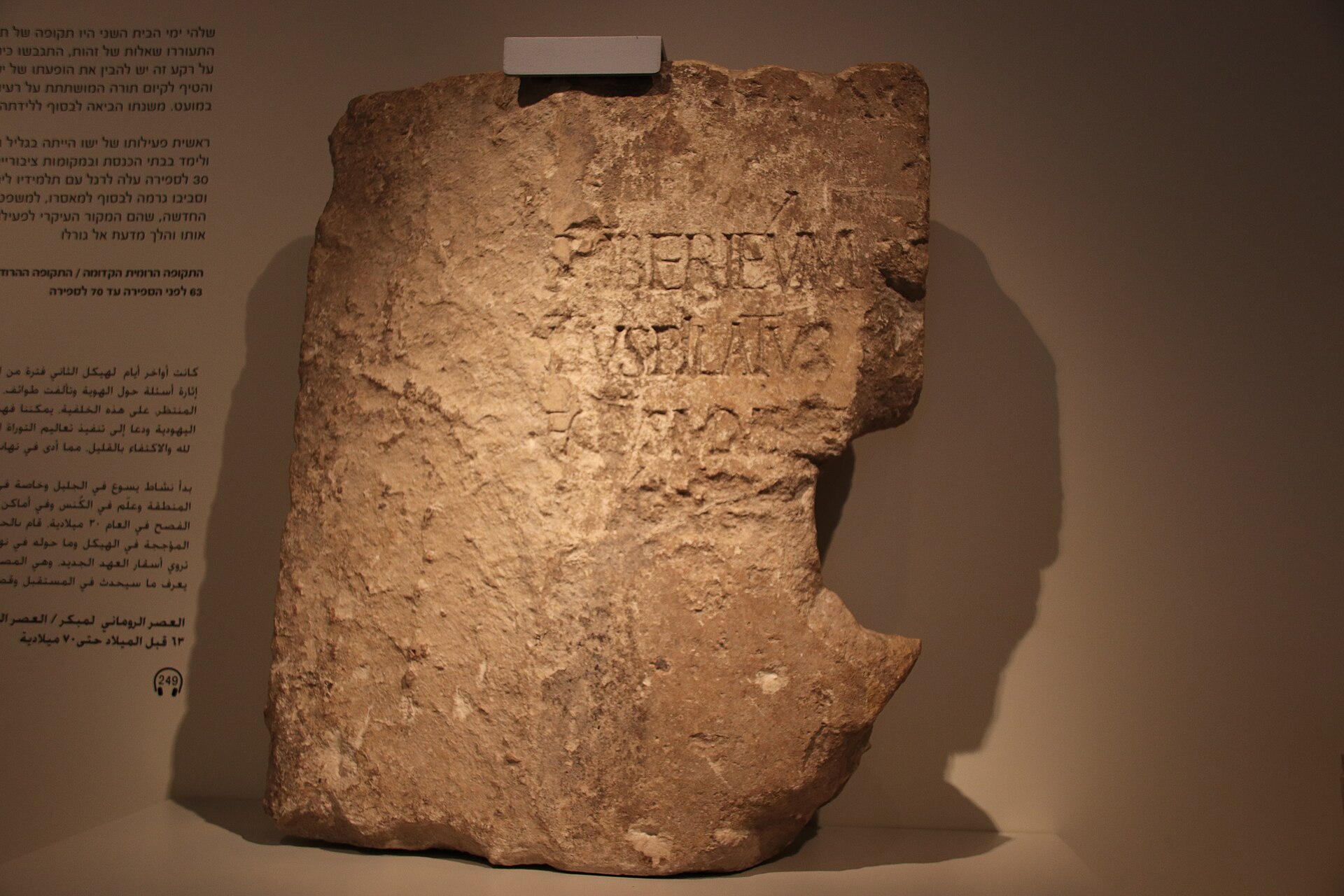
The inscription from Caesarea confirms that Pontius Pilate held office in Judea. It names Pilate, not Jesus. Establishing that the governor existed does not establish the Gospel trial or the identity of the person said to have appeared before him.
Later notices answer a different question
Josephus wrote Jewish War decades after Pilate’s governorship and Antiquities in the 90s CE. This site treats the Testimonium Flavianum in Antiquities 18 as a Christian interpolation and the ‘called Christ’ clause in Antiquities 20 as an interpolation; neither passage is a contemporary report. The Josephus page examines the wording and surrounding sequence.
Pliny’s letter to Trajan describes people in Bithynia who sang to Christ and their practices as a community. It does not name Jesus, describe his life, or identify a source for a first-century biography. Tacitus’ Annals 15.44 is also later; this site’s Tacitus page examines its Christus wording, transmission, and lack of a named source.
The Marcion chronology concerns when a Gospel and letters attributed to Paul enter the documentary record in this site's reconstruction. Tertullian gives the interval later used to calculate c. 144; he is not reporting from a document dated 144. Justin names Marcion earlier but does not list a Gospel or Pauline collection. Irenaeus and Tertullian give later descriptions of those texts.
Why the silence matters
No independent, contemporary source establishes the central biographical claims. The texts that supply those claims are later literary works. The external notices most often cited either concern Christian groups decades later or depend on disputed wording and transmission.
The gap matters because first-century dates for the narratives are inferred from literary and historical arguments. A proposed composition date cannot turn a later narrative into a contemporary witness. The case rests on the chronology and character of the texts, not on a list of famous writers who failed to mention Jesus.
Josephus does not establish the Gospel Jesus
The Testimonium Flavianum in Antiquities 18 contains Christian confessions about Jesus as Messiah, resurrection, and fulfillment of prophecy. This site identifies the whole paragraph as a Christian interpolation; Eusebius gives the first known quotation of its received form.
Antiquities 20 contains the phrase about James and Jesus “who was called Christ.” Read in sequence, Josephus describes Ananus' removal and then names Jesus son of Damneus as the new high priest. This site identifies the Christ clause as a Christian insertion. The passage supplies no account of Jesus' life. The Josephus page examines both passages in context.
Tacitus does not supply an independent witness
Annals 15.44 says Christus was executed under Pontius Pilate and describes the movement's presence in Rome under Nero. Tacitus wrote generations after the alleged execution, gives no source for the claim, and does not name Jesus.
This site reads the Christus identification as a Christian interpolation. The notice documents a later Roman account of Christians; it does not provide an independent contemporary record of Jesus or his execution. The Tacitus page examines the wording, source question, and manuscript transmission.
What the documentary record establishes
The sources establish the development of Christian texts, beliefs, and communities. They preserve arguments over scripture, rival Gospel forms, and the authority later writers assigned to apostolic figures.
Those facts document Christianity's history. They do not supply a contemporary account of Jesus' life or verify that the Gospel narratives describe a first-century human founder.
Source and transmission audit
The contemporary record and its later witnesses
| Date or period | Source | What it says or does | What it cannot establish |
|---|---|---|---|
| c. 4 BCE–30 CE (proposed) | Proposed lifetime | No contemporary text names Jesus or records the Gospel execution narrative. | The dates describe a later reconstruction, not a period established by a contemporary record. |
| c. 40s CE | Philo, Embassy to Gaius 299–305 | Describes Pilate’s shield dispute and Jewish-Roman tensions. | Philo does not mention Jesus or supply a biography of him. |
| c. 70s CE | Josephus, Jewish War 2.169–177 | Recounts Pilate’s standards incident and aqueduct dispute. | Josephus wrote later and does not mention Jesus in this account. |
| c. 93–94 CE | Josephus, Antiquities 18 and 20 | Contains the two passages cited as references to Jesus. | This site treats the Testimonium and the ‘called Christ’ clause as Christian interpolations; neither is contemporary. |
| c. 112 CE | Pliny, Letters 10.96–97 | Describes a Christian community that sings to Christ and Pliny’s inquiry into its practices. | It documents worship, not Jesus’ life, execution, or an eyewitness source. |
| c. 116 CE | Tacitus, Annals 15.44 | The transmitted sentence links the name Christus with an execution under Pilate and a movement in Rome. | Tacitus gives no source for the sentence; its title for Pilate conflicts with his contemporary inscription and is one feature in this site's cumulative interpolation case. |
| c. 144 CE (reconstructed) | Marcion corpus in this chronology | Reports about Marcion provide the first documentary references to a Gospel and letters attributed to Paul. | The date is calculated from later testimony; no document from 144 lists the collection. |
How the pieces fit
The documentary sequence is second-century. The letters do not establish a first-century author named Paul, the Gospels are anonymous literary narratives, and later Jewish and Roman notices do not provide independent contemporary testimony. Taken together, the sources support the conclusion that Jesus was a literary figure, not a historical founder.
Conclusion
Jesus did not exist as a first-century human founder. Christian texts and communities are historical; the biography's Jesus is a second-century literary creation.